The pilot went well. The team liked it. The executives nodded along. Then the next budget round arrives and the question that comes back is a single sentence: what did we get for what we already spent. And the best answer anyone can find is that the team works faster, which nobody can carry one step further into where the company earned more money.
This is not happening only at your company, and not only in Thailand either. It already has a name.
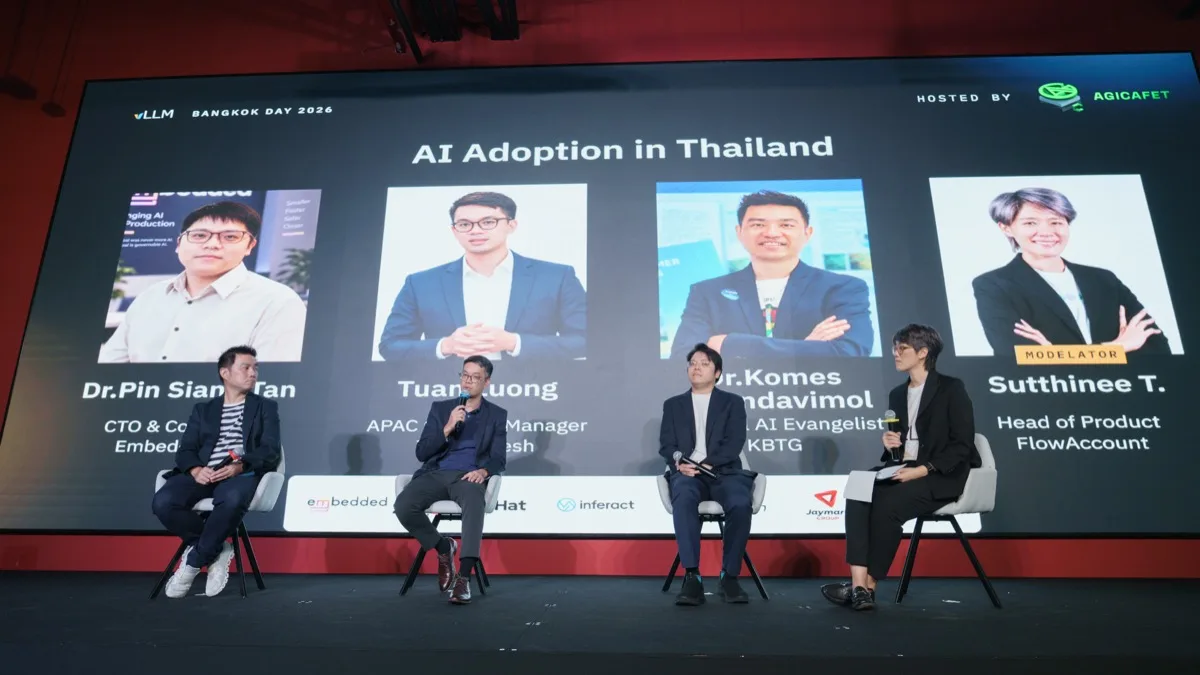
We moderated the panel "AI Adoption, What Actually Works" at vLLM Bangkok Day 2026, wrote all 6 questions ourselves, and deliberately picked people who sit at different points of the same chain rather than 3 speakers saying the same thing in 3 accents.
- Dr Pin Siang Tan (Embedded LLM) makes models run on the customer's own machines, including serving that keeps the data inside the building
- Tuan Luong (Tensormesh) drives the cost of serving down at the source, and can compare across countries in this region
- Dr Komes Chandavimol (KBTG) has to make AI work inside the bank, and sits closest to the market
We run product at FlowAccount, so we walked into this panel with the questions of someone who has to ship, and who has to answer for what the money bought.
Part 1Why can an organisation not prove AI works, when the people inside it clearly can
The organisation cannot prove it because what it can see is the gain of one person, not the gain of a whole workflow. Tuan calls this the productivity paradox.
At the individual level the result is unmistakable. Nearly everyone sitting in that room works with AI every day already. Step back to the whole organisation and it stops being provable: nobody can point to where the real work got better. The money went out, and no one is confident about what came back. The person who signs the next round of budget has to see the return before they keep paying.
He was also clear that this is a global problem, not an ASEAN one, and expects the gap to narrow over the next one to two years.
Answering one of the later questions, he played the most useful card of the whole panel for anyone who has to walk into an executive's office. There are exactly 2 questions that senior decision makers actually ask.
How much more money will AI make me?
And how much will it save me?
Everything else is a pitch from the bottom up, and it fails the bar in its first sentence. Walking in and saying that you saw a new technology at an event and would like to try it loses to those 2 questions every single time.
The other half of the answer comes from the large enterprise
Komes walked through the sequence KBTG followed. His starting point was measuring how ready the people were, and tools came after that.
Three years ago, when ChatGPT had just landed, everybody assumed that everybody already knew how to use it. When KBTG, a technology company, actually measured, the number came back at roughly 80 to 90% already using it. That group is the early adopters, the ones who pick up something new on their own without anyone pushing them. Everybody else has to be designed for, one group at a time.
Developers were already past the assistant stage. Coding assistants and productivity tools were all in hand and AI had become their partner, not a new thing that needed introducing.
This year KBTG lined the work up in 3 beats: use it the right way first, then go for productivity, then go for impact. Next year is when the impact of each individual gets aggregated into something bigger and pushed out to the customer.
Part 2The PoC that passes and then goes nowhere: the problem is too little ambition
What separates the demo that makes a room say wow from the system that survives real traffic? That was the question, and Pin Siang's answer came back inverted from what we expected.
Most PoCs are aimed too low. AI adoption usually starts as a three month PoC whose target is only to be as good as a traditional software system, which is already below what AI can do today.
The measurement frame he says does not work is "make every employee 50% faster". The bosses he talks to hand it back: if the employee is 50% faster, maybe they just spend longer in the pantry. The frame that does work is superpower, meaning work that was simply not possible before. Last year that meant OCR reading text out of images, and pulling sensitive data out of transcripts. This year it means a team of 10 shipping at world class quality, when reaching that level used to require world class talent in the room.
And that kind of thing never shows up in a short demo. The only way to see it is to put it in production and give everyone agentic AI credits. The result shows itself within about 2 months (agentic AI being AI that takes a job through its own steps, instead of stopping at answering a question).
The part outsiders cannot see is people and process
We asked what outsiders cannot see. Komes said the tools are the part everyone has looked at already. What is left backstage is people and process.
The starting point is giving foundation AI knowledge to everyone first, because the person who builds the pilot is not the developer any more. A knowledge worker can build an agent today. Once the foundation is there, you climb a staircase where each step spends more of the company's money.
Box 1 · The 3 gates before production
| Stage | Passes when | Company gives | Limits |
|---|---|---|---|
| prototype / MVP | anyone may build, no conditions | tools | none |
| pilot | you can say where the value or company impact is | playground · credits · more tools · platform access | tested on employees only, no customers yet, and time boxed |
| production | you state the exit criteria first | the right to roll out at full scale | measured against the criteria you announced |
The middle step is the one people skip. Testing on your own employees first is not cowardice. It is agreeing to fail while failing is still cheap. And for the last step there is exactly one gate: say which ending counts as success, before you begin.
Part 3When should you self-host, and when should you call an API
We asked for a decision rule the room could take home and use. Tuan answered with 2 cases where the customer called him directly.
- A team running roughly 100 billion input tokens per month, watching the GPU bill climb every month, calling to ask how to push it back down
- A company in Thailand that set an AI budget of USD 500,000 per month for 1,000 developers, burned the entire month's budget by mid month, and had to stop development across the team
He said plainly that the bill is the very first factor because it is the thing customers call about. Latency, meaning how long the system takes to answer, plus sovereignty and data residency policy, came afterwards as things you have to look at. A few minutes later he called sovereignty very important, so the order he said things in cannot be read as a weighting.
Box 2 · Deciding between self-host and API
There is one more thing people get wrong regularly. Hardware that looks bad is usually hardware that has not been tuned. One customer was running 8 consumer grade gaming GPUs and reported poor performance.
The Embedded LLM team, who are AMD specialists, went in and tuned inference from that starting speed toward the machine's roofline. The result came back 50 to 100 times faster, tuned to match the shape of that customer's workload: low concurrency (not many people using it at once), a need for low latency, and usage that stays local.
That number does not mean every machine will get the same. It means that if you have never tuned, the number you are making the decision on may not be what your machine can actually do.
When the question came back to us, about where our own house sits against this rule, the answer is squarely on the API side. We use frontier models, the top tier models from the big providers, running in the cloud on the customer facing side, reached from MCP server tools, the standard channel that lets a model pull our data and drive our systems. We do not serve a model of our own yet. Which is exactly what the line above predicts, because we do not own GPUs.
Going deeper: When to self-host an LLM · Renting a GPU to run your own model · Matching the model to the job
In Vietnam, what pushes GPUs into the country is the law. Tuan described a banking and finance sector there that is not allowed to use public APIs at all. A number of banks now run GPUs themselves, some rented from local providers, some as their own in bank cluster. The rules force the cards to sit inside the border, and that is precisely the field where an optimisation company like his competes against the public APIs.
Part 4Sovereignty you can actually answer starts with 4 questions
Sovereignty is a word everyone says and nobody defines the same way. Tuan went at the term itself: IT has spent two decades being very good at inventing complicated words nobody understands, and open source belongs in that group too.
Right now the internet offers sovereignty level one, level two, level three and highest, with no standard behind any of them and nobody knows how you are supposed to reach those levels.
The definition he offered instead is one short phrase: control as much as possible of what you have. Then he broke it into questions that can actually be answered.
Box 3 · The 4 sovereignty questions you must be able to answer
The interesting part is that he deliberately left model choice open. Use whatever you want, as long as you can control it.
What to build yourself and what to simply take from others
Pin Siang split it into 3 piles.
- Build yourself meaning tuning inference to match your own workload. If you own the GPUs and you know the shape of the work you are aiming at, there is a lot of performance still sitting in the hardware you already have.
- Take meaning calling different providers' APIs. This is the popular route, and the cost is good relative to the productivity you get.
- Ship as product meaning something like their TokenVisor, which lets the customer choose which provider to use while all the controls sit on the customer's own server. Inside it are guardrails, a per person token quota, rate limits, and routing that decides which project goes to an API, which one self-hosts, and which one goes to provisioned cloud GPU. A guardrail is the rule that fences off what the model may and may not answer. A rate limit is the ceiling on how many calls you get in a given window. They call the whole piece an AI firewall: the gate that sits between the people in the company and the model.
As for what they push upstream, back into the original project for other people to build on, he gave the reason without dressing it up: not because they are kindhearted, but because this industry moves fast enough that what you push up comes back to you as community work built on top of it.
He answered the ASEAN question without flattering the region either. If you sit down and count how many developers from ASEAN actually have their name on those projects, you can see the region is still at the level of picking things up and using them, not yet at contributing. The hope he left behind is the younger generation now stepping into the global game.
Part 5Governance today is not control, it is allocation
In most people's heads, governance means the thing that slows you down. So we asked the opposite question, and Komes' answer threw the definition out.
Governance used to mean control. Now it means allocation.
It starts with people again. Thailand has developers, it has AI builders who assemble solutions, and it has researchers building Thai LLMs. Governance's job is to let people pick the right tool for the right job.
- The token budget is the main lever, and its size comes from the value of the project. Work with organisation level impact gets a lot of tokens. "I want AI to generate an image or a song" gets the tools and a few days, because the impact is small.
- You state the success criteria before you start. The process asks up front what the impact is and how it will be quantified. Budget and deadline are approved against that answer.
- Governance does not stop at go live. It used to end there. With AI that customers touch directly, you keep watching for the model making things up and for infinite loops, you watch every token spent against the impact and performance it bought, and if something is wrong you have to be able to take the product back.
- The funnel numbers he gave: roughly 1,000 ideas, down to hundreds of MVPs, down to around 10 pilots. And converting a pilot tested on 100 people to a customer base of around 20 million counts as its own governance stage, because the token cost does not scale in the same proportion.
- Which makes a fallback plan mandatory. If you withdraw the AI product, the customer still has to be served, or what you lose is their trust.
Those funnel numbers are what you can put in front of an executive straight away, because they say that pilots dying along the way are the normal shape of the process.
The vendors see governance as a trust question too. Pin Siang said governance is what lets your customer trust you. On a day when most of the job is handed to AI, the promise you made to your customer rides on every request the system is watching, counted in billions of tokens, and every one of them has to stay inside the company's rules.
What they actually built has 2 layers. The first is an AI firewall where an admin sets prompts that stop intellectual property from leaking: you specify exactly what must not get out, and the model will not cross that line. The second is TokenVisor Spaces, a secure sandbox holding several agents together, where the agents can only reach the documents placed in that space. A different customer's project gets a different space, with per project authorisation and RBAC from day one, so access follows each person's role.
The design goal he stated is worth writing down: simple enough that management understands it, because only the thing management understands actually protects the company.
Going deeper: Tiering decisions by who has to be in the loop · Designing agents that have to last
Part 6The long tail of the market, and who does which part
The long tail is the enormous population of small businesses at the end of the curve. We asked this question on behalf of the people who work with them. A great many of our customers have no IT team at all, and have never heard the phrase fine tuning, which means taking a model and training it further on your own data.
If AI is going to reach them at all, it will arrive inside the tool they are already paying for not as something they have to go and build. The question is who does which part: the engineers, the software vendors, or the government.
We had to ask this question twice before it landed, and the first pass went to large enterprises instead, which is a small piece of evidence for the thing this whole article is about. People at different ends of the same chain do not automatically use the same words. Tuan, who spent 12 years growing an open source user group in Vietnam into a community companies rely on, answered in 3 parts.
- Engineers' job is to use it every day until it is normal, and to keep sharing. He says he cannot work without it now.
- But engineers cannot move AI adoption in a large enterprise or in government. That is a story of investment, of money, and of policy makers. A pitch from the bottom up always loses to the question from the top down about how much it saves or how much it earns.
- Government in ASEAN follows the giants taking the more powerful countries as the reference and then adapting to local culture. His advice is to be patient with them, and to expect very large differences over the next year or two, as every ASEAN government tries to apply AI.
Komes answered from the seat of a bank that has to look after both itself and its SME customers.
- For engineers start with responsible AI from the beginning. When you pick something open source, understand what it is, and own the quality of the output that comes out.
- For the SMEs with no engineer and no IT he was very direct: this group relies on neither engineers nor government. They rely on themselves. The minimum competence is being able to check the answer. When the model responds, can you tell whether this is the right answer to the question that was asked, and do you know whose model this is and whose software that is. All of it comes down to floor level AI literacy: knowing how to use Google, plus being able to validate what comes back.
- The business fundamentals have not changed. It is just faster and more complex. An SME that wants more revenue or lower cost still needs AI, used responsibly and understood well enough to check before believing.

Part 7The chain nobody can move alone
For the closing round we asked 2 things. First, what each of them will do in the next 12 months to help this move. Second, what they need from the others on stage. There are 5 things you can pick up and use immediately.
Put AI on rails that are already running. Tuan's advice to enterprises was to go and look at the workflows already running in your company, pick the easiest one, put AI there first, evaluate it, and write the policy from the result. Not write the policy first and then go looking for somewhere to put it.
Stop giving instructions and start giving the outcome you want. Pin Siang described the technique he uses himself. Instead of saying make this PowerPoint, add this, add that, say that this presentation has to win the customer, and then ask what you should do. He said this is the best time there has ever been to start, and pointed at one person companies now running business models that were not possible before. His closing words were get hungry and get foolish, his own phrasing of Steve Jobs.
The work AI can take over has already left the screen. Pin Siang described friends in the solar power industry using AI to identify viable locations for panels, where roughly 90% of the work is done by agents and the people left just help the company get the panels installed. He added that government giving everyone access to AI is a good place to start. AI that leaves the screen and enters the physical world
Learn to tell good AI from bad AI. Tuan compared it to the cloud wave, which produced a whole generation of cloud engineers and certifications. AI is a bigger wave than cloud, and no engineer will survive without knowing it. Not at the level of algorithms, but at the level of using it, and of telling which one is good and which one is not, at a moment when every piece of software is labelled smart something. His closing line was not to take it too seriously. Just learn it and use it every day, and the knowledge will soak into your work by itself.
Watching from the sidelines teaches you nothing. Komes left the line that matched the panel's title: take action, test, run a PoC, and most importantly understand where the model failed and where it did not, then learn from what it produced and go round again better.
Lay all the answers side by side and what comes up is the shape of the problem. A large enterprise can fix people and budget allocation, but cannot bring the cost per token down. The people who make the model run can pull performance out of the hardware, but cannot write another company's policy. And the people who make serving cheaper only get to change the numbers in the equation. The Thai company that set USD 500,000 a month and burned it by mid month was not waiting for a cheaper price per token. It was waiting for someone to say who gets how much, and that is not a job a vendor can do for you.
So we closed the panel on one sentence. AI adoption is not about who has the best model. It happens when the technology, the organisation and the economics all move together, and no part of that chain can move it alone.

This panel happened because the vLLM Thailand team brought an event of this level to Bangkok, and because Job Natdhanai from AGICAFET trusted us with the mic.
Sources and references
- All content comes from the panel "AI Adoption, What Actually Works" at vLLM Bangkok Day 2026, streamed on 6 September 2026. The author moderated that panel.
- vLLM Bangkok Day 2026 event site
- Full event stream (Creatorsgarten)